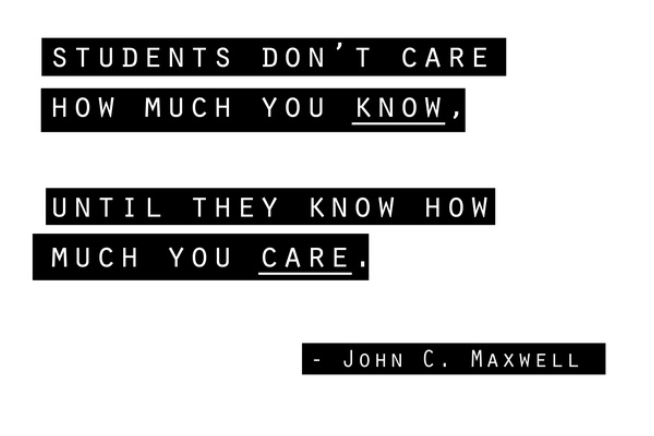
Building positive relationships with your students is an integral part in creating an environment where all students feel safe, welcomed, and respected. Building relationships with your students is hard, for some of your students that positive relationship will come easy, for others it might take a while. Some students may struggle with the idea of having a positive relationship with others, because they might not know what that looks like (as heartbreaking as that sounds).
There will be students that lash out, talk back, ignore you, bother other students, eat their homework because they don’t want to do it, get others off task, and so. Instead of feeding in to their inappropriate behaviors, you use different strategies to discourage their inappropriate behaviors. One of the important things to remember is you don’t want to draw negative attention to negative behaviors. Drawing negative attention will only escalate the behavior, which doesn’t help you build the relationship with the student.
If you can reteach a concept in Math, you can reteach behavior. This can be done by going over the classroom and/or school expectations, you aren’t drawing negative attention to the individual behavior but rather using it as a segway to a teachable moment. This doesn’t have to be a whole class moment either, and in some cases it would be best to approach the individual and talk to them individually.
Redirecting is used when you are trying to keep other students from being distracted, this way the student is thriving off the attention that others give them but instead drawing attention away from the student. One of my elementary school teachers took a different approach to redirection, she redirected the student causing the behavior by letting them draw (Their favorite thing to do) just for a few moments and then the student was fine. She gave the student a task instead of redirecting the whole class.
The use of signals and nonverbal cues are also extremely important. I popular signal is the teacher saying “Class, Class” to which the students respond “Yes, Yes”. My mother uses “Scooby-Doo” and the students respond “Where are you” (I’m assuming because I was obsessed with that show as a kid), but it works. Signals can be an array of things, anywhere from a gesture, phrase, action, sound, almost anything. Nonverbal cues are what I like to call “Mother’s/Father’s repertoire” because we all know that look our parents gives us when we are doing something we aren’t supposed to be doing, nonverbal cues aren’t limited to looks, they can also be gestures, various action or hand signals. In the past I had spent enough time in the Mother’s classroom where apparently I developed the “bubblegum face”, where if a student saw it they know they got caught eating gum and would go spit it out. A lot of students would be frustrated but would comply, others wanted to know how I knew to which I always told them I was in school too, so I know all the tricks.
No matter what intervention you use, treat the student with respect and kindness, afterall you are trying to build a positive relationship with them.