Ms.SammyK

Learning. Growing. Educating.

Bullying Prevention Through Understanding Motives — November 29, 2018

Bullying Prevention Through Understanding Motives

We all want to think that bullying doesn’t occur in our classrooms, but it most likely is we just aren’t fully aware. Most schools have a zero-tolerance policy yet bullying still occurs.

Bullying is not a new concept, in the spirit of the upcoming holiday the movie “A Christmas Story” Ralphie and his friends, were bullied by none other than Scut Farkus (interestingly enough in trying to find how to spell the bullies name, the actor who played him, Zack Ward is raising money to help launch an anti-bullying campaign using his character as inspiration). Ralphie and the gang frequently attempted to run away from Farkus and his ragtag group of fiends sometimes they were successful other times not so much. One day Ralphie has enough and slaps Farkus (I also discovered, that Ward was being slapped by the actor who played Ralphie, which is why his cheeks turn red). Farkus was a bully, but was Ralphie?

According to stopbullying.gov, in order for a behavior to be considered bullying, it must be aggressive, and an imbalance of power (bullies using their power to control others and possibly harm others), and the behavior needs to be repetitive. By this definition Ralphie would not be a bully, although his behavior causes physical harm to another. Defining bullying can be difficult especially in a school setting, because you wouldn’t want to say to a student oh well “it’s not bullying till they do it again”. That’s not going to make the student feel better about the situation and the parents or guardian isn’t going to like that response either. But what motivates a person to start bullying?

Most bully’s don’t bully without a reason some may not have a reason, they just did it because they could. For those that have a motivation it usually is something that enables them to gain something from bullying. STOMP Out Bullying is the leading anti-bullying/cyberbullying organization through the United States. As per their slogan they want to “Change the Culture” of students they list some possible motivations behind why students may bully others, they feel relieved from their feeling helplessness and overpowering someone who they deem weaker makes them feel strong, some bullies may have a poor self image and bring others down through rumors and just being mean make them feel better about themselves, some bullies are well liked by most but plan their attacks strategically so that their victim appears to be the one that has an issue with the bully and the last motivator listed by STOMP Out Bullying is the bully is socially inept and doesn’t really know how to act.

When it comes to bullying and bullying prevention it important to know what to do when bullying occurs; tell someone, a lunchroom worker, the school counselor, coach, music teacher, P.E. teacher, tell any adult you trust just tell someone. Some suggestions given by stopbullying.gov include a range of different methods, from activities to teach students about bullying (I like the classroom meetings, which can be done daily to check in on students), having an evidence based bully prevention school program, and train staff/faculty on bullying prevention. STOMP Out Bullying provides suggestions that are more geared toward what you can do to stop bullying, like tell an adult, be a friend to the person who is being bullied, stand up to the bully, and Pay it Forward which their sticky messages (basically a post it notes with a positive message to pass on). These are just a few ideas, but make it known in the classroom that bullying won’t be tolerated because this is a space where everyone is welcome and wanted, building positive relationships with students will help with this, but also building relationships among peers will be great for this.

I hope everybody has a safe and happy holiday!
Fostering a Growth Mindset — November 22, 2018

Fostering a Growth Mindset

“All Students Can Learn”

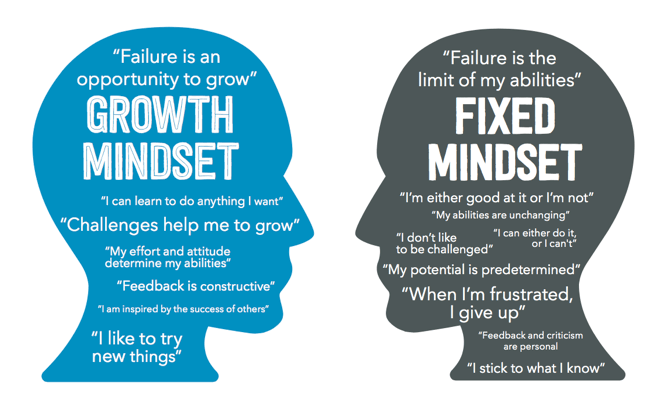
I took this quote from Dr. Rachel Turney from a recent video of hers that went over understanding what a growth mindset is. Without hesitation all teachers should know that all their students can learn. It may not be the way you would like them to learn, but they can learn and will learn if you help then to grow out of fixed mindset.

A good environment that fosters endless learning, the idea that failures aren’t failures but opportunities to improve, a place that allows students to try new things, or use different methods that they may have never thought of will help start to grow students growth mindset. Think of the book The Little Engine That Could, he went from thinking he could do it, to knowing that he could do it. Self-perseverance, plays a huge roll in that book, because it took dedication, continuous effort, despite the challenges that faced him. Student need to feel like if they fail it’s not the end of world, that it’s something they can use to improve themselves.

I am in no way saying that it will be easy, because it won’t be. I myself still struggle getting myself out of the fixed mindset. It is important to take this growth step by step, because a fixed mindset can be the result of trauma, or have some type of roots in taruma. You can have both a fixed mindset and a growth mindset depending on various situations and that’s okay, it only becomes an issue when you start relying more on your set in ways.

I have always struggled with thinking I am not smart, because growing up I wasn’t as academically successful as my older brother, there were things that I was good at (remembering random information that only comes in handy for Jeopardy), but I never felt smart. I always worked harder than my brother but still I felt all my effort wasn’t worth it. I even had a teacher that told me I was never going to be good at math (I’m not joking). Jokes on her! I’m great at upper level math! I took Calculus my senior  year of High school without ever having to take Pre-Calculus, and I passed the class with 105%. My schooling got better when I was in an environment when the teachers stopped or couldn’t compare myself to my brother (switched to a private high school my brother never attended). Had I stayed in the environment where teachers would see my last name and automatically assume how I was going to do, I do not think I would be the person I am today. There’s a quote about growth mindset that fits into this perfectly “When a flower doesn’t bloom you fix the environment in which it grows, not the flower” (Alexander Den Heijer). Change the environment change the mind.


Building Relationships Through Behavior Intervention — November 16, 2018

Building Relationships Through Behavior Intervention

Building positive relationships with your students is an integral part in creating an environment where all students feel safe, welcomed, and respected. Building relationships with your students is hard, for some of your students that positive relationship will come easy, for others it might take a while. Some students may struggle with the idea of having a positive relationship with others, because they might not know what that looks like (as heartbreaking as that sounds).

There will be students that lash out, talk back, ignore you, bother other students, eat their homework because they don’t want to do it, get others off task, and so. Instead of feeding in to their inappropriate behaviors, you use different strategies to discourage their inappropriate behaviors. One of the important things to remember is you don’t want to draw negative attention to negative behaviors. Drawing negative attention will only escalate the behavior, which doesn’t help you build the relationship with the student.

If you can reteach a concept in Math, you can reteach behavior. This can be done by going over the classroom and/or school expectations, you aren’t drawing negative attention to the individual behavior but rather using it as a segway to a teachable moment. This doesn’t have to be a whole class moment either, and in some cases it would be best to approach the individual and talk to them individually.

Redirecting is used when you are trying to keep other students from being distracted, this way the student is thriving off the attention that others give them but instead drawing attention away from the student. One of my elementary school teachers took a different approach to redirection, she redirected the student causing the behavior by letting them draw (Their favorite thing to do) just for a few moments and then the student was fine. She gave the student a task instead of redirecting the whole class.

The use of signals and nonverbal cues are also extremely important. I popular signal is the teacher saying “Class, Class” to which the students respond “Yes, Yes”. My mother uses “Scooby-Doo” and the students respond “Where are you” (I’m assuming because I was obsessed with that show as a kid), but it works. Signals can be an array of things, anywhere from a gesture, phrase, action, sound, almost anything. Nonverbal cues are what I like to call “Mother’s/Father’s repertoire” because we all know that look our parents gives us when we are doing something we aren’t supposed to be doing, nonverbal cues aren’t limited to looks, they can also be gestures, various action or hand signals. In the past I had spent enough time in the Mother’s classroom where apparently I developed the “bubblegum face”, where if a student saw it they know they got caught eating gum and would go spit it out. A lot of students would be frustrated but would comply, others wanted to know how I knew to which I always told them I was in school too, so I know all the tricks.

No matter what intervention you use, treat the student with respect and kindness, afterall you are trying to build a positive relationship with them.

  CT3_Relationships

Support Systems aren’t just used in time of need — November 6, 2018

Support Systems aren’t just used in time of need

Having good support system can make a huge difference in someone’s life not just in times of need but at all times (which I think some people forget). We all have those that we can go to if we need help, but we also have those that we can go to just for the sake of being able to go to them.

Support Systems, can be comprised of whoever you want your support system to include, typically the supporters that make up the system includes, friends, family, colleagues, bosses, and even sometimes animals (because they love unconditionally). As a student you may have a support system founded within the walls of the school as well as one outside the classroom. In our classroom we will have students that may not have a good support system or perhaps they may not have a support system at all.

Ruby Payne identified seven general categories of how support systems can be utilized; Coping Strategies, Provide various options to help problem solve, information and know-how, providing relief in terms of mental/emotional/financial and time management, networking (connecting to other people/resources), creating Positive Self-Talk, and procedural self-talk that helps you get through a task.

There are three of these categories that stick out to me, and usually are the categories that students that are low income/poverty tend to struggle with, coping strategies, positive self-talk, and procedural self-talk.

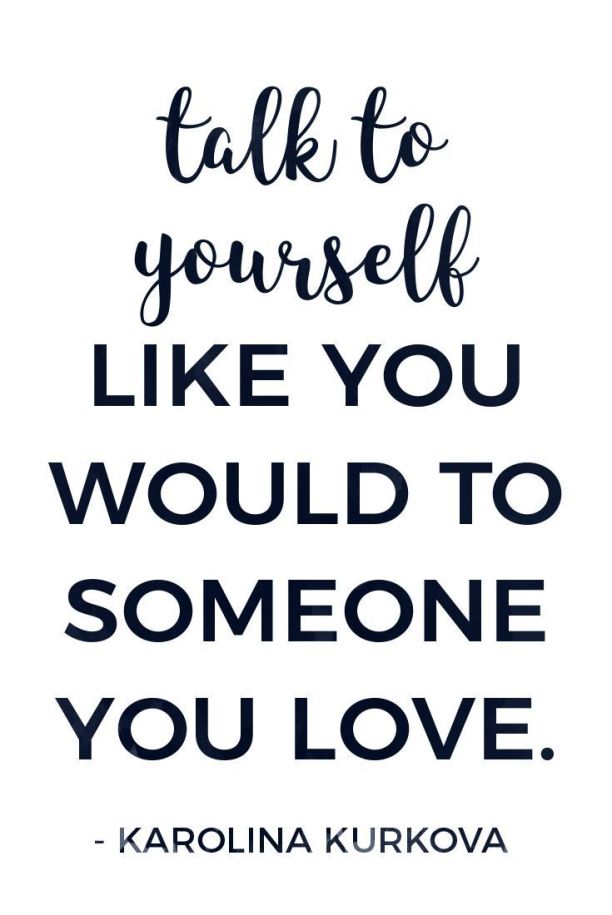
Teaching students these three skills will not only help them in the present time, but also as they grow older. I know for me personally, I do not have any sort of Positive Self-Talk and it can be extremely difficult at times because I have such a negative view of myself it can actually hinder my success at times. So I understand that teaching self-talk at an early age is really important when it comes to the mental and emotional development of a person. In my dorm room I have a little wooden sign that reads “I am enough”, because that is something I struggle with daily, so I read it every morning and it reminds me that I need to be nice to myself. In your class you may want to have daily affirmations that are posted in the room where it can be seen by everyone throughout the entire day and have your students say it outloud first thing in the morning.

When it comes to teaching coping skills, you also need to teach that there are healthy coping skills and unhealthy coping skills. You want your students to have healthy coping skills so that it helps the students learn and grow rather than suppress keep all the negative inside which can become toxic for the individual.

Some unhealthy coping skills are but not limited to: bottling up feelings, working too much, avoiding your problems, and blaming yourself and others for various things. Healthy coping skills can grow and become unhealthy, so teaching your students the line between what is healthy and what is not is important too.

Procedural Self-Talk reminds me of The Little Engine That Could, I think I can, I think I can, which leads to the statement I know I can. This can be taught by teaching the importance of planning, chunking, and just through encouragement that they might not get anywhere else.

Teaching these three categories are in my opinion imperative, because if a student can’t find support within themselves other aspects of their daily life can be affected. Be kind to yourself!

selftalk


Finding Interventions That Work — November 1, 2018

Finding Interventions That Work

No two students are alike, not even identical twins. What works for one student may not work for the rest of the students in your class. As educators we want the needs of our students to be met, we want them to feel like in this class they are being nurtured so that they can succeed. How we set up our class, and how we handle day to day incidents in our classroom can greatly affect students. Through some research I found that the majority of interventions either have to do with the set of up of the classroom: rules, clear expectations, changes in work settings, provide rubrics, making the classroom as a whole safe; or just building up a child’s soft skills, and recognizing each individual as just that an individual that has their own needs, and that they each have their own personalities and what treated as such.

Interventions are created to help behavior, understanding that some students may need more structure when it comes to their behavior management, others might need constant reassurance that they are doing ( usually popular with students that have anxiety, or students that have had/or are dealing with some type of trauma). Some students will need to cool down without being punished for needing to cool down. Getting to know your students is extremely important, because then you can know what you need to do and what intervention you can put into place to make your class successful for them.

I did find a Non-profit organization that is based in Milwaukee that has a list of 101 Classroom Interventions

They do have some bolded choices, but the one that was bolded that stuck out to me was, Smile. Teachers aren’t perfect, we have bad days too but if we don’t smile even on our worst days it would make the learning environment uncomfortable for some, because you may be their only source of positivity and for them seeing their teacher smile helps to relax. Our actions, our presence, our tone all impact the classroom it affects the students and the overall environment.

Not all intervention are going to work for the same people, because we are all different, we have different needs, we all learn different, we are all just different. Let’s embrace all the differences and make a welcoming environment that fits and meets the needs of all our students.

WordPress7

How Our Learning Styles Impact The Classroom — October 26, 2018

How Our Learning Styles Impact The Classroom

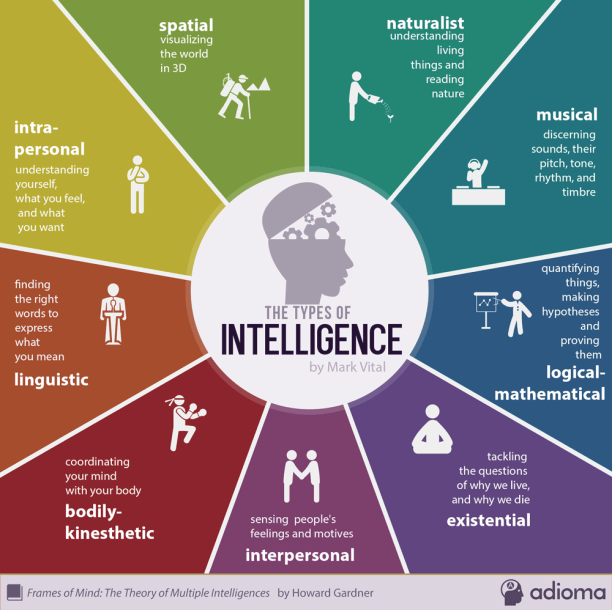
9-types-of-intelligence-infographic

We all learn in different ways, some may work better alone while others work better together. Some may do better when hands on work is involved, others may strictly be visual.

There is no right way to learn, because everyone learns differently.

In a classroom setting you are going to have different learning styles to take into account, some student may have layered learning styles, I know for me after taking several of the different learning styles assessments out there without fail Intrapersonal and Naturalist are almost if not equal. I know I work best alone, and being in a setting where others are around me make it difficult to learn, even during college I spent 98.99% (the other 1% is being in class or at work) of my time in my bedroom studying  alone. In the classroom this can be difficult because the student is always going to be around others. You may opt to have a quiet learning area that’s still apart of the whole but far enough away from the core that the the student can be successful.

Getting to know your students individually will not only help build relationships with the students, but also how to plan lessons so that all students can be successful in the classroom. While it may be incredibly hard to incorporate all learning styles into every single lesson, you should still have a variety within each lesson. If you do find a way to incorporate all learning styles successfully into one lesson please contact me, because I’m genuinely curious to see how that can be done. Incorporating the different learning styles into the daily classroom experience not only helps the student to be successful but to feel successful as well.

Creating a Vision and Mission to Improve School Climate. — October 22, 2018

Creating a Vision and Mission to Improve School Climate.


WPClimate

As Teachers we should want our students to feel connected to the school and their individual classroom. It gives the students a sense of security that they might not have anywhere else. The idea of connectivity is to bring students together with a clear vision of where you are going based on the mission of where you are. All students are equal and all students deserve respect, when a student feels like their voice is heard they open up, the school becomes more than a school it becomes a safe place where they can leave everything at the front doors and they get to be themselves.

Mission

Our School has set expectations that helps this institution to be a safe place for all students that promotes connectivity, by abiding by shared values that all students are equal. Where teachers/parents/students alike come together to create a cohesive positive environment where all students succeed in growth of knowledge and knowledge of one’s true self.

Vision

To create a positive environment that fosters engagement, equality , and respect while meeting the needs of all students to create students that are lifelong learners that are inspired and achieve success.


Teaching Those Who Have Trauma — October 17, 2018

Teaching Those Who Have Trauma

There will be times a student is going through something that you have no background in, and it is terrifying for both the student and teacher. We want to be there for our students, and sometimes that can be really hard when you aren’t sure what the student needs.

More often than not, our students come from a different background than what we do and with that comes its own challenges, the main challenge being you (the teacher) don’t understand how deal with something we have no background in. I know for me personally I am fortunate enough to have grown up in a two parents household, and I know not everyone has that same experience and I need to understand the legal issues that go with that. A child may be in court a lot because the parents are arguing about custody, or child support payments. This situation has the potential to create issues later in life for the child going through this, they may not be able to connect with others in fear they will leave them, they may not be able to have healthy relationships with potential partners because they know what it’s like to sit the courtroom and see two people who once loved each other battle it out to see who gets them.

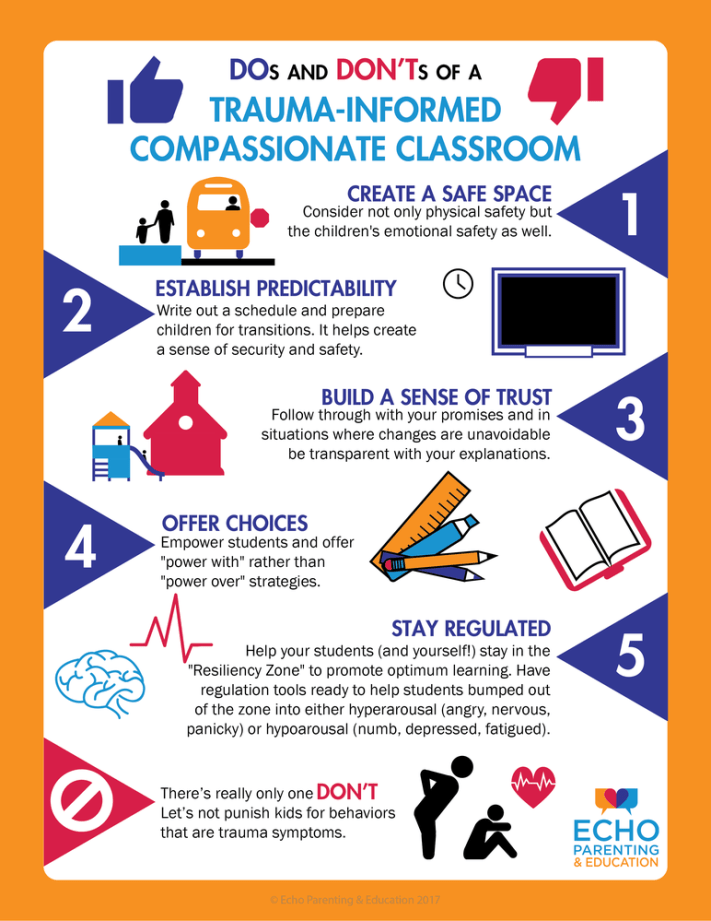
As a teacher you have to understand that trauma has many forms, and can manifest in a student in many different ways. A teacher also has to understand that there is a possibility every student in the class has been through or is going through some degree of trauma. Trauma looks different for everyone, but the teacher needs to be aware of any type of trauma in your school district, but also how to teach those who have trauma. Sounds, actions, words may trigger a student and you have to cautious to either avoid to alert the student (one-on-one) that a situation could come up, that way the student can prepare themselves.

Below I am attaching a link that has 10 tips for Teachers that have students with trauma.

https://www.weareteachers.com/10-things-about-childhood-trauma-every-teacher-needs-to-know/

Be mindful of your classroom, understand that while you are struggling to help the student manage and cope with their trauma, that this is really hard for the student because they are the ones going through it. Believe me, they wish it wasn’t like this either.

Understanding Poverty — October 10, 2018

Understanding Poverty

Living in Poverty means more than just having money issues. While that is a big contender when dealing with poverty it’s just not the only thing in play. It is extremely hard to understand something you haven’t gone through, and typically the teachers that teach students living in poverty are from the Middle Class. This can be extremely discouraging to the students, but also for the teacher as well because they don’t understand what the student is going through, or what they need from you as their teacher.

Schools are helping in the ways that they can, either by BuddyPacs (an organization that supplies food for children over the weekend), some schools are now even providing laundry services to student who either don’t have running water at home, or have to go a laundromat where it could cost upward of 5 dollars per load. Another thing that I have seen schools do is have travel size hygiene products for those student that may not have shampoo or soap at home. Schools wants to provide students with the resources they need to succeed no matter the socioeconomic status of the child

We see our students for a few hours everyday, and we may have no idea what their home life is like. We may not know if that child has a good support system or even if they have one to begin with, they may not be able to channel their emotions in a healthy manner because they may not see the adults in the their life handle their emotions,, the student may not know where their next meal is coming from, if they will return home only to find they are being evicted. All of these situations takes a toll on a child in their mental and physical development because their day to day needs aren’t being met.

Its heartbreak as a teacher because if you are aware that the student struggling because of living in poverty, you don’t know what you can do to help them both in and out of school. I can’t attest to what teachers can do outside of school, but during the school day be the students champion, show them that they matter to you, that you care about them, take their life into consideration and what may or may not be a trigger to the student. Overall, just be kind, welcome them in the morning with a smile on your face even if it is met with a tinge of anger, be that positive person in their life that keeps pushing them to be the best person that they can be. Let them know that you are there for them, and choose kindness.


Rozner, L. (Writer). (2018, August 16). School adds laundry room so all kids can have clean clothes[Television broadcast].                         Newark, NJ: CBS.
Self Determination — September 27, 2018

Self Determination

selfdetermination

We all have different reasons to why we pursue the things we do, and that because something has motivated us to do so. In everything you do there is a driving force behind it. Motivation is either Intrinsic or Extrinsic, meaning we either do things because something within us drives us to do so or we do things because of the outcomes or an outside force.

Self-Determination is defined at the process by which a person controls their own life.

There are several things that motivate me in my life in pursuit of becoming an educator, my love of learning that was passed down from my parents. We are that family that when we go on Vacation we tend to see Historical sites or attend various Museums, this love of learning has extended into the some of television through various Canceled TV series like Relic Hunter, and Warehouse13. I love to help others, and I believe everyone deserves an equal chance when it comes to education. But, also and probably the biggest driving force in my life, is I want my students to know that they can overcome anything thrown at them. For those that know me in my personal life, know that I have struggled with my health, schooling, and just overall life in general. I want my students to look at me and say “If she can overcome the obstacles thrown at her, I can too”.

According to the research by Richard Ryan and Edward Deci, “To be motivated means to be moved to do something”. They describe that there are different kinds of motivation besides that of Intrinsic and Extrinsic, they look at it as the level of motivation and the orientation of the motivation. So how motivated is the student and what is the driving force behind what they are doing (Ryan, & Deci). The Self Determination Theory which Ryan and Deci were “The Founding Fathers” of, talked about the basic human need of Autonomy and Freedom. Students want to be their own person even in a classroom setting, and that extends farther than the outward appearance of the clothes they wear, but it also reaches to how/what they learn. If they are learning about something that interest them (Intrinsic), they will complete the tasks at hand out of curiosity, but if they are learning or reading something that they have no interest in that task rivals that of pulling teeth.

For a student to become more self-determined in a classroom, the classroom environment should fulfil three basic needs; student need to feel connected, the classroom itself should be effective (think about Effective Classroom Practices), and students should be responsive to learning new things (Ryan & Deci).


Ryan, R. M., & Deci, E. L. (2000). Intrinsic and Extrinsic Motivations: Classic Definitions and New Directions. Contemporary Educational Psychology, 25(1), 54-67. doi:10.1006/ceps.1999.1020


Create your own website, free on WordPress.com.Create your own website.
Start free